Water damage guide
Ceiling Water Damage in Scottsdale: Causes, Repair, and Cost
A stained or sagging ceiling almost always means an active leak above it, and ceiling water damage can be repaired, but only after you fix the source and dry the cavity overhead. The brown ring on your ceiling is a symptom; the water sitting in the joists, insulation, or subfloor above is the real problem. Painting over the stain without drying what's above it just hides damage that keeps spreading. This guide covers what causes ceiling water damage in Scottsdale homes, when it's dangerous, how repair works, what it costs, and how insurance handles it.
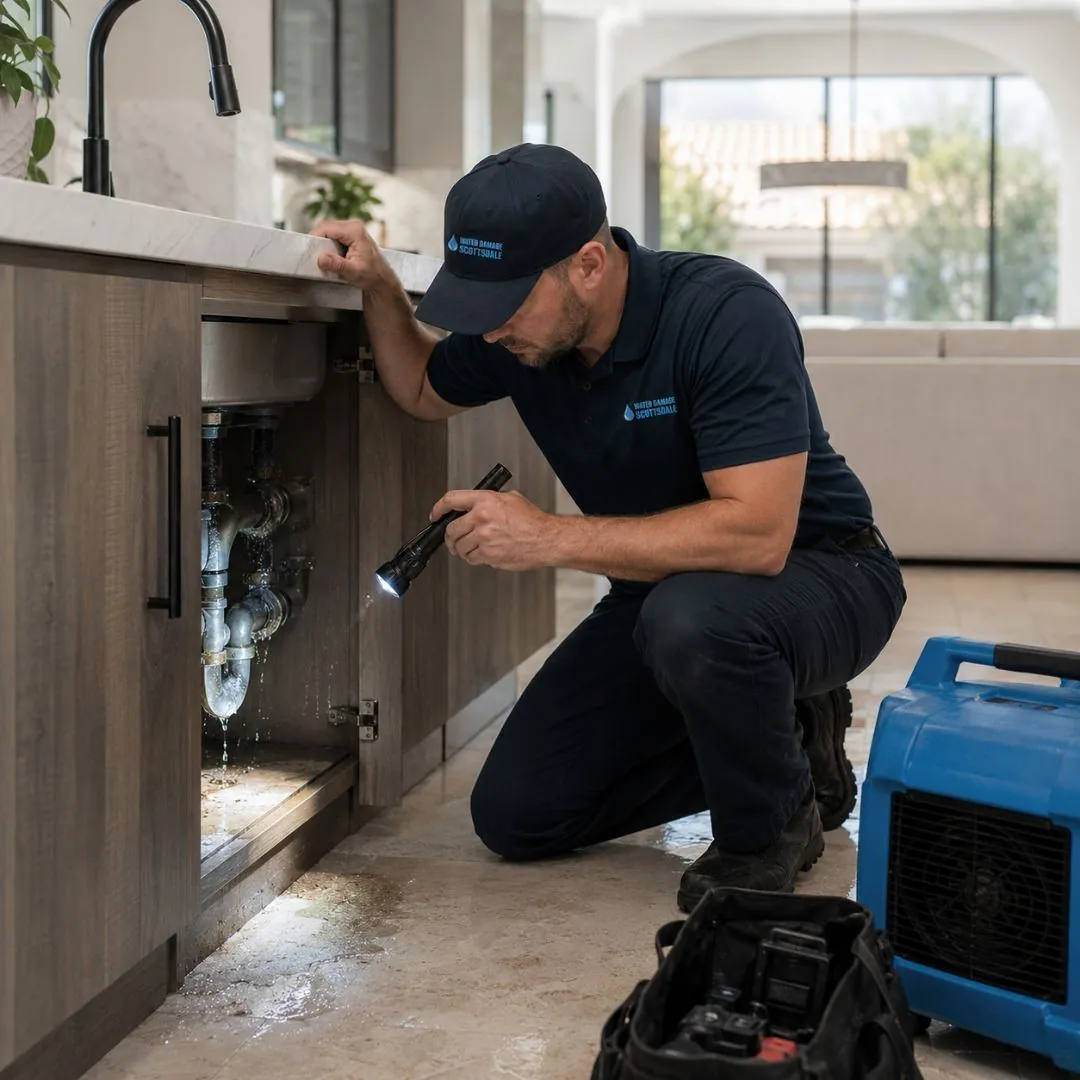
From our experience in Scottsdale: ceiling water stains are often traced back to leaking attic AC condensate lines or roof intrusion after monsoon storms. One of the biggest mistakes homeowners make is painting over the stain before finding the source, because the visible spot can be much smaller than the moisture damage hidden above the ceiling.
What causes water damage on a ceiling?
The most common causes are a roof leak, plumbing on the floor or in the bathroom above, and, in Arizona homes especially, attic air-conditioning condensate lines and monsoon-driven roof intrusion. Where the stain sits usually points to the source: directly under an upstairs bathroom points to plumbing, while a stain near an exterior wall or one that appears right after a storm points to the roof.
| Likely cause | Where the stain tends to show | Tell-tale sign |
|---|---|---|
| Roof leak or monsoon intrusion | Near exterior walls or roof penetrations | Appears or worsens right after a storm |
| Upstairs bathroom or plumbing | Directly below a bathroom, kitchen, or laundry | Stain grows when fixtures above are used |
| Attic AC condensate line | Below or near the attic air handler | Shows up in cooling season, often mid-room |
| Overflowing tub, appliance, or toilet above | Below the fixture that overflowed | Sudden, large stain after a known overflow |
Because the water travels along joists and drips at the lowest point, the stain is often several feet from the actual leak. That is why a proper repair starts with finding the source in the space above, not with the ceiling itself. If the source is a hidden supply line, our burst pipe detection and repair can locate it before more of the ceiling is lost.
Is a water-damaged ceiling dangerous, can it collapse?
Yes, a badly water-damaged ceiling can collapse, because wet drywall and plaster get heavy and lose their strength. A ceiling that is bulging, sagging, or actively dripping is the warning sign to take seriously: stay out from under it, move anything valuable, and treat it as urgent.
There is an electrical risk too. Ceilings hold light fixtures, fans, and wiring, so water tracking through a ceiling can reach them. If a fixture is dripping or the ceiling around it is wet, cut power to that area at the breaker before anyone goes near it, and don't switch those lights on until it has been checked.
How fast does mold grow in a water-damaged ceiling?
Mold can begin to grow within 24 to 48 hours on wet materials, and ceilings are especially prone because the insulation and framing above them stay damp and hidden. The EPA advises drying water-damaged areas and items within 24 to 48 hours to keep mold from taking hold.
With a ceiling, the visible stain is the smaller half of the problem, the attic insulation and the top of the drywall can stay wet long after the surface looks dry. Drying that hidden cavity, and keeping indoor humidity below 60 percent, is what actually prevents mold. Fast structural drying above the ceiling matters more than anything you do to the surface. If mold has already appeared, see our guide on how to get rid of mold after water damage.
Can you just paint over a water-stained ceiling?
No, not until the leak is fixed and everything above the ceiling is dry. Painting over a stain traps moisture and any mold underneath, and the EPA warns that paint applied over a moldy surface is likely to peel. The stain will usually bleed back through ordinary paint anyway.
The right order is: fix the source, dry the cavity above, remove or replace anything that grew mold, and only then seal the old stain with a stain-blocking primer before repainting. Skipping to paint is the single most common ceiling mistake, because it hides a problem that keeps spreading out of sight.
Can the ceiling be repaired, or does it need replacing?
It depends on how saturated the ceiling got and for how long. Lightly stained drywall that is dried quickly can often be sealed and repainted, while drywall that sagged, crumbled, or grew mold is cut out and replaced. The EPA notes drywall can be dried in place when there is no swelling and the seams are intact, but once it swells it has to come out.
Two ceiling-specific cases usually mean replacement rather than repair: wet attic insulation above the ceiling, which mats down and won't dry inside the cavity, and textured or "popcorn" ceilings, which are difficult to patch invisibly and are often re-done in the affected section. Whatever the finish, the drying above the ceiling has to be verified before any new material goes up, the whole job is only as good as the drying underneath it, which is the core of proper water damage restoration.
How much does ceiling water damage repair cost in Scottsdale?
Ceiling repair costs track three things: the size of the damaged area, whether the leak source needs its own repair, and whether mold had time to set in. A small, single stain caught and dried early sits at the low end; a sagging, multi-room ceiling with wet insulation and a roof repair on top runs far higher.
For a sense of scale, the Insurance Information Institute puts the average water-damage-and-freezing insurance claim at about $13,954, the second most common homeowners claim after wind and hail. That is an insured-loss average across all water damage, not a ceiling quote, the only way to a real number is an on-site look. Our guide on water damage restoration cost breaks down what drives the price. You can request an estimate to get one.
Does insurance cover ceiling water damage?
Usually yes when the cause is sudden and accidental, a pipe bursting in the wall or floor above, or an appliance overflowing, and usually no when it is a slow roof leak that was left unaddressed, which insurers treat as a maintenance issue rather than a covered loss. Our full guide to homeowners insurance and water damage covers mold, roof leaks, and filing a claim. That sudden-versus-gradual line is where most ceiling claims are won or lost.
Flooding is separate: FEMA notes most homeowners policies do not cover flood damage, so water entering during a monsoon storm is only covered with a flood policy. Document the ceiling with photos and note when you found it, and know that the Insurance Information Institute's claim category for water damage and freezing includes mold when the underlying event was covered. Coverage decisions are ultimately between you and your carrier.
What to do the moment your ceiling starts leaking
Move furniture and valuables out from under the leak, put down a bucket and towels, and, if the ceiling is bulging with trapped water, pierce a small hole at the lowest point of the bulge to drain it into the bucket and relieve the weight before it lets go on its own. Then cut power to any lights or fans in that area at the breaker.
After that, the priority is finding and stopping the source and getting the cavity above dried inside that 24-to-48-hour window. That is exactly what fast water mitigation is for, and the sooner it starts, the more of your ceiling can be repaired instead of replaced.
Ceiling water damage FAQs
What does a water stain on the ceiling mean?
It means water is getting in from above, usually a roof leak, plumbing on the floor above, or an attic AC condensate line. The stain is a symptom, so the active source overhead has to be found and fixed before the ceiling is repaired.
Can a water-damaged ceiling collapse?
Yes. Wet drywall and plaster get heavy and lose strength, so a bulging or sagging ceiling can give way. Stay out from under it and cut power to any fixtures in that area until it is inspected.
Can you paint over a water-damaged ceiling?
Not until the leak is fixed and everything above is dry. Paint over a moldy or wet surface tends to peel and the stain bleeds back through. Once it is dry and clean, seal the old stain with a stain-blocking primer, then repaint.
How fast does mold grow in a ceiling?
Within 24 to 48 hours on wet materials, according to the EPA, and ceilings are especially prone because the insulation and framing above stay damp and hidden. Drying the cavity above within that window is the best prevention.
Does insurance cover a ceiling leak?
Usually yes for a sudden event like a pipe bursting upstairs, and usually no for a slow roof leak left unaddressed, which is treated as maintenance. Flooding from outside the home is excluded and needs a separate flood policy.
Ceiling leaking in Scottsdale?
The faster the source is stopped and the cavity above is dried, the more of your ceiling can be saved. Reach out for a fast response and a clear plan.