How Much Does Water Damage Restoration Cost in Scottsdale?
September 9, 2026
What restoration actually costs, what drives the number up, and where insurance picks up the bill.

Water Damage Scottsdale
Emergency water removal, cleanup, structural drying, and repairs for homes and businesses across Scottsdale. Call any hour and speak to someone who can send help.
A water emergency can turn a normal day into a stressful one within minutes. Water Damage Scottsdale helps homeowners, business owners, and property managers get control of emergency water damage with prompt restoration, cleanup, drying, and repair across Scottsdale, AZ. Whether the issue starts with a plumbing leak, a burst pipe, water heaters, a dishwasher line, or flood damage after a monsoon storm, the focus is on protecting the structure and helping you move forward.
We built this service for local property owners who want clear answers, steady communication, and careful restoration services from people who understand local homes and buildings. From Old Town condos to desert estates, from retail spaces to offices, we bring a practical water damage restoration process that starts with inspection, continues through careful water extraction, and finishes with cleanup, drying, sanitizing, and repairs.
The first hour usually decides how big this gets. Water keeps traveling after the leak stops, moving under tile, into baseboards, and across the slab, so the goal right now is to stop the spread and keep people safe.
The 24 to 48 hour window: the EPA advises drying wet materials within 24 to 48 hours to prevent mold growth. That window is the practical difference between a drying job and a remediation job, and it is why response time matters more than almost anything else on this page.
A few things to avoid: do not run the HVAC if water reached ducting or the air handler, do not rely on a household shop vac for anything larger than a small spill, and do not assume a surface that feels dry is dry. Hidden moisture behind baseboards and under tile is what causes the second round of damage weeks later.
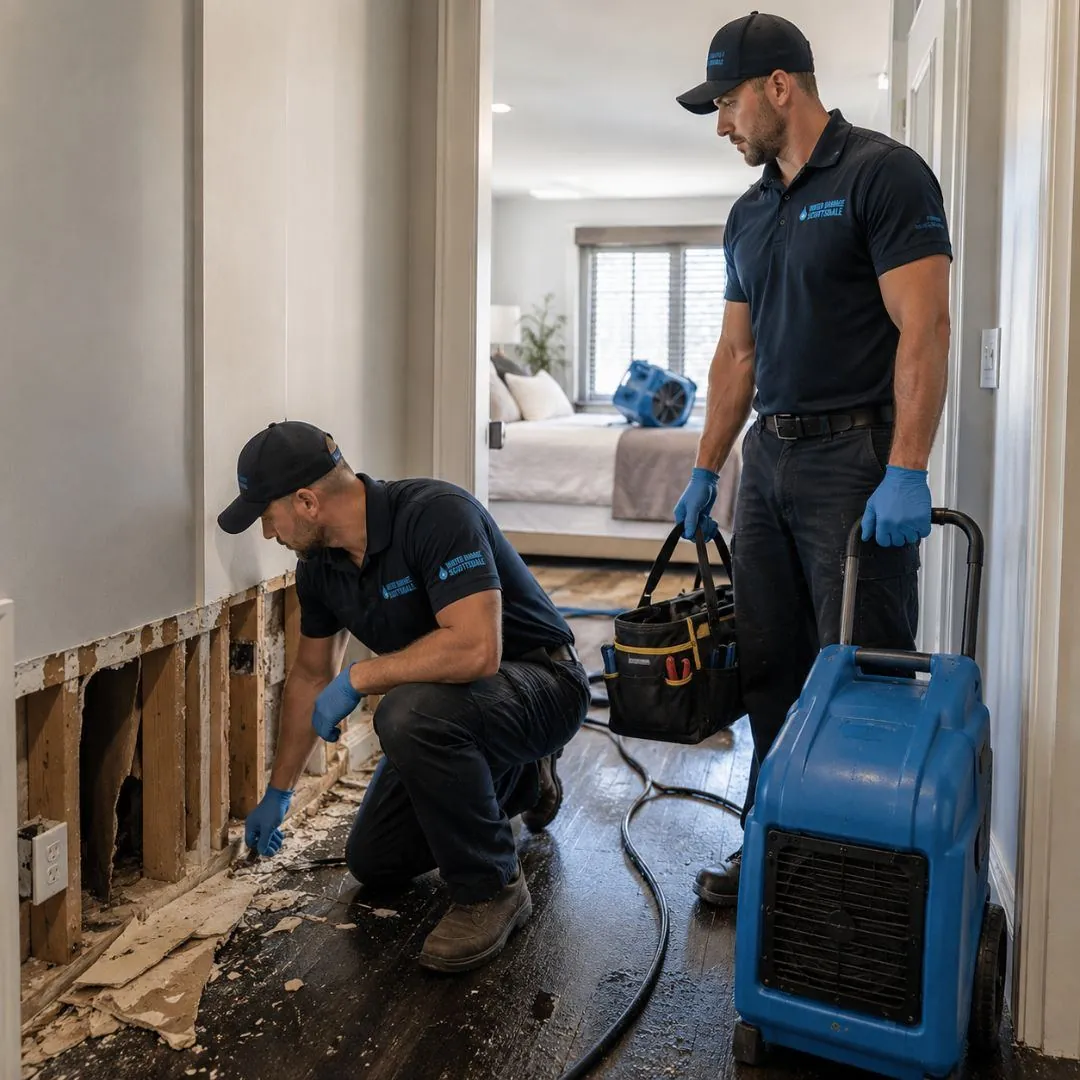
Local building stock shapes the losses we see. Slab-on-grade construction, tile over concrete, stucco exteriors, low-slope roofs, hard water, and a monsoon season that arrives in bursts all make some properties more susceptible to water damage than others.
Copper supply lines run under the slab in much of Scottsdale, and years of hard water thin them from the inside. The tells are a warm spot on tile, a water bill that jumped for no reason, or the sound of running water with every fixture off. Older South Scottsdale and Old Town homes see this most.
Most tanks live in the garage or a hall closet and give out somewhere around year eight to twelve. When the tank itself splits, forty to fifty gallons land at once and run toward the lowest point in the house. What to do when a water heater leaks.
An Arizona classic. A clogged condensate line backs up in the attic or closet and shows up as a ceiling stain in the middle of July, often after weeks of quiet dripping. See ceiling water damage for what that repair involves.
From July through September, wind driven rain finds roof penetrations, scuppers, and patio door thresholds. Hillside lots in Troon and North Scottsdale also take on fast runoff that pushes water at the garage and the back of the house.
The braided hose behind a washing machine, a dishwasher supply, a refrigerator ice maker line. These fail quietly, often against a shared wall or into a cabinet base, and are frequently found only when the flooring starts to cup.
A burst pipe inside a wall, a failed angle stop under a sink, or a broken irrigation line that saturates soil against the foundation. Water leaks outside the building envelope still find their way in through the slab edge.
Every job is different, but the sequence rarely changes. Knowing the order makes it much easier to tell whether the crew in your home is working a plan or improvising.
A technician traces the source, then uses moisture meters and thermal imaging to map how far the water traveled through your home or business. This is where the real extent of the water damage gets established, usually well past the visible edge.
Standing water comes out first with truck-mounted extraction and portable units. Fast water extraction removes the bulk of the excess water before it can wick further into walls and subfloor.
Saturated carpet pad, swollen baseboard, cabinet toe kicks, and drywall below the wet line come out when they cannot be dried in place. Removing less is always the goal, but trapped moisture behind a wall dries no other way.
Air movers and dehumidifier equipment run until daily readings confirm the assembly is dried properly, not just dry to the touch. Most contained clean water losses run three to five days.
Affected surfaces are cleaned, treated with an antimicrobial where appropriate, and deodorized. Gray and black water losses get a heavier clean-up scope, and mold damage found along the way moves into remediation.
Drywall, texture, paint, trim, flooring, and cabinetry go back in. Water damage repair is what actually returns the space to its pre-damage condition after the drying equipment leaves.
You should receive moisture readings at the start and at the end, photos of what was removed, and a scope you can hand to an adjuster. Ask for those three things from any water damage restoration service before demolition begins. More on how mitigation differs from restoration.
The IICRC S500 standard sorts water losses into three categories. The category drives what can be saved, what protective measures the crew uses, and what the job costs.
| Category | Where it comes from | What it means for the work |
|---|---|---|
| Category 1, clean water | Supply lines, water heaters, a burst pipe, an overflowing sink | Most materials can be dried in place. Drying is the main task, and the job is usually the least expensive of the three. |
| Category 2, gray water | Appliance discharge, toilet overflow without solids, aquariums | Carries contaminants. Porous materials such as carpet pad come out, and remaining surfaces are cleaned and sanitized. |
| Category 3, black water | Sewage backup, storm and flood damage, any water that sat long enough to spoil | Biohazard handling. Porous materials are discarded, containment is set, and protective equipment is required throughout. |
One detail worth knowing: clean water does not stay clean. Left sitting for a couple of days in a warm house, a Category 1 loss degrades into Category 2, which is another reason a same-day response saves money rather than costing it.
Most jobs land in the low thousands, and the spread is wide. Angi reports a national average near $3,868, with a range from roughly $450 for a small contained spill up to $16,000 for a large contaminated loss. Insured claims skew higher because bigger events are the ones that get filed: the Insurance Information Institute puts the average water damage and freezing claim near $13,954.
Five things move the number more than anything else: the category of water, the size of the affected areas, how long the moisture sat, whether mold developed, and how much material has to be replaced rather than dried. Only the first two are set by the event itself. The other three are decided by how fast the response starts, which is the practical argument for calling before the weekend rather than after it. See the full Scottsdale cost breakdown.
Most standard homeowners policies cover water damage that is sudden and accidental, which is why a failed water heater or a burst supply line is usually a covered loss while a slow drip behind a cabinet often is not. Outside flooding sits outside the standard policy entirely and is handled through the National Flood Insurance Program.
What helps a claim move is documentation gathered from hour one: dated photos, moisture readings, a written scope, a list of affected materials, and records of the work performed. That record is what an adjuster uses to separate a sudden event from gradual seepage, and it is the single most useful thing a homeowner can have during insurance claims. How water damage coverage works in Arizona.
Full restoration, cleanup, repair, mitigation, burst pipe support, and structural drying for residential and commercial properties across the city.
Full-service restoration for floods, storm damage, and moisture problems in Scottsdale properties.
Learn more →Help for wet rooms, soaked flooring, debris, odors, and contaminated water after water intrusion or flooding.
Learn more →Repair support for drywall, trim, flooring, cabinets, and finishes after damage caused by water.
Learn more →Mitigation that limits damage, removes water, and helps protect materials after water intrusion.
Learn more →Help finding burst pipe damage, stopping water spread, and restoring what the failure touched.
Learn more →Measured drying for walls, flooring, framing, cabinets, and hidden moisture after water damage.
Learn more →Our crews cover the whole city and the surrounding areas throughout Arizona, from Old Town and South Scottsdale up through North Scottsdale, and we can reach nearby Valley cities such as Glendale when schedules allow. Each neighborhood has its own mix of building styles, drainage patterns, roofing concerns, and plumbing ages, so some properties are more susceptible to water damage than others, and we do not treat every loss the same.
A Scottsdale home near an older commercial corridor may face different water leaks than a newer property farther north. A commercial property near Old Town may need after-hours cleanup to reduce disruption. A hillside home in Troon may need careful inspection after storm runoff. Wherever you are throughout Scottsdale, the goal is the same: fast response, thorough drying, and water restoration work that helps return the property to its pre-loss condition.
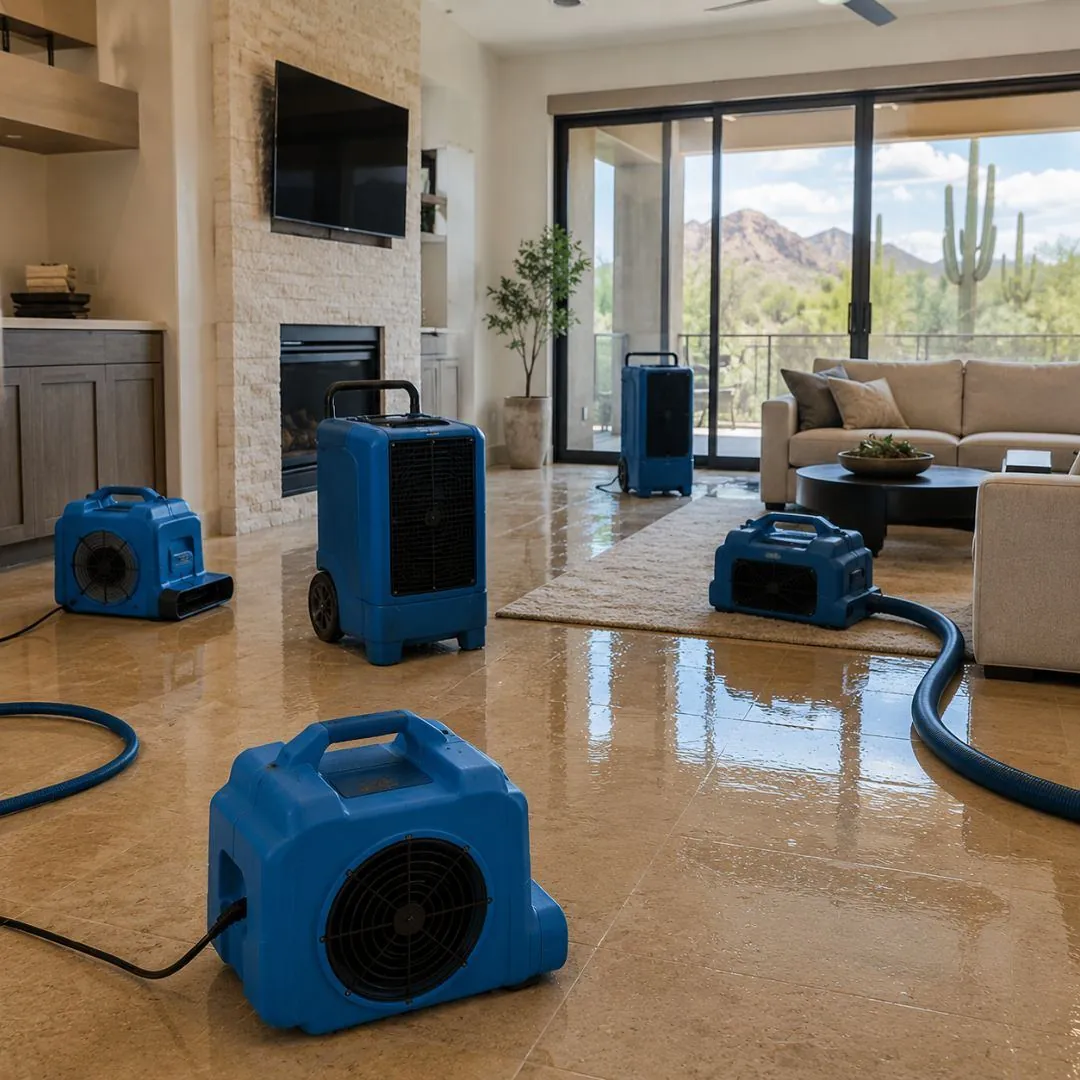
We understand local homes, businesses, monsoon weather, slab construction, tile floors, and the way moisture moves through properties here.
We explain what is wet, what can be saved, and what the next step looks like before work begins.
When it comes to water damage, response time matters. Our team moves quickly to limit additional damage and begin emergency water removal.
Technicians use advanced equipment and the latest technology, including moisture meters, air movers, and dehumidifier gear, so wet materials are dried properly instead of relying on guesswork.
We help homes and businesses recover from office spills, retail flooding, commercial water losses, and after-hours needs at a commercial property.
We document moisture readings, photos, affected materials, and each step of the work so property owners have organized information for the claims process.
Water Damage Scottsdale was built around a simple observation: when water is spreading through a property, the hardest part is often the first hour. Property owners are stressed, the damage is getting worse by the minute, and finding the right help feels like a second emergency. This service exists to remove that friction. One call connects you with restoration professionals who serve Scottsdale, explain the work in plain language, and move quickly to protect the structure.
The teams we work with stay highly trained and certified, follow IICRC-certified drying standards, and treat documentation seriously, recording moisture readings, photos, and each step of the restoration process. That paper trail matters for the claims process, and it matters for peace of mind. From the first inspection to the final moisture check, the goal is steady communication and work that returns your property to its pre-loss condition. That is what being the reliable experts neighbors call first actually means to us.
More about usRestoration covers the full sequence from inspection through repairs: locating the source and mapping hidden moisture, emergency water removal, removing materials that cannot be saved, structural drying with air movers and dehumidifier equipment, cleaning and sanitizing affected areas, and rebuilding what was removed. Mitigation is the emergency half that stops the damage from spreading, and restoration is the half that returns the property to its pre-loss condition.
Most jobs land in the low thousands. Angi reports a national average near $3,868 with a range of roughly $450 to $16,000, and the Insurance Information Institute puts the average water damage and freezing claim at about $13,954, which reflects larger insured losses. The category of water, the size of the affected areas, and how long the moisture sat matter more than the leak itself.
Extraction usually happens on the first visit. Structural drying commonly runs three to five days for a contained clean water loss, with daily moisture readings deciding when equipment comes out. Dense materials such as hardwood, plaster, and concrete hold moisture longer, and sewage or storm losses take longer because materials have to be removed before drying starts. Repairs are scheduled after the structure is dried properly.
Minor water damage is clean water on a hard surface, caught within a few hours, that has not reached drywall, cabinets, subfloor, or insulation. A cup of water knocked onto tile and wiped up the same day is minor. Once water travels under tile or laminate, wicks up drywall, or soaks carpet pad, it is no longer a surface problem, because the part you can see is rarely the full extent of the water damage.
Often yes for a small clean water loss in one room, as long as electrical hazards are controlled and drying equipment can run. You should not stay in a property affected by sewage or contaminated water, where the electrical system got wet, where ceilings or floors are sagging, or where mold has spread. A restoration technician can tell you which situation you are in after an inspection.
Standard homeowners policies generally cover sudden and accidental water damage, such as a burst supply line, a failed water heater, or an appliance that lets go. Damage from long term seepage, poor maintenance, or outside flooding is typically excluded, and flood coverage is bought separately through the National Flood Insurance Program. Policies vary, so check your declarations page and call your carrier early.
The common exclusions are gradual leaks that went unnoticed, damage traced to deferred maintenance, ground water and surface flooding, and in many cases sewer or drain backup unless a backup endorsement was added. Mold damage is often limited or capped, especially when it grew because a known leak was left unaddressed. Documenting the date you discovered the loss helps show it was sudden.
Ask who is actually performing the work, whether the crew follows IICRC-certified drying standards, and whether they will show you moisture readings at the start and at the end. Ask for a written scope before demolition, ask how many drying days they expect, and ask how they document the loss for the claims process. A damage restoration company that will not put the drying plan in writing is one to pass on.
You can handle a small, clean water spill on a hard surface with towels, fans, and a wet vacuum if you get to it immediately. Rented fans do not measure anything, which is the problem with larger losses: consumer equipment cannot find hidden moisture behind baseboards or under tile, and a surface that feels dry can sit over saturated subfloor. Gray water, contaminated water, and anything that reached drywall or cabinets calls for professional water damage restoration.
Untreated moisture leads to mold growth, swollen and delaminating flooring, warped trim and cabinets, stained ceilings, corroded fasteners, and eventually weakened framing and subfloor. There is also a paperwork risk: waiting can give an insurer grounds to argue the loss was gradual rather than sudden, and Arizona sellers generally have to disclose known water damage, so unrepaired damage follows the property.
The EPA advises drying wet materials within 24 to 48 hours to prevent mold growth. That window is the whole reason response time matters, because a job dried inside two days is usually a drying job, while the same loss found a week later often turns into remediation with material removal.
Yes. Sewage and storm water may carry bacteria or another contaminant, so the area is isolated, the water is removed, porous materials that absorbed it are discarded, and remaining surfaces are cleaned and sanitized. That clean-up is handled differently from a fresh supply line break, where most materials can be dried in place.
Straight answers on water damage repair, restoration, and prevention for Scottsdale, AZ homeowners and property managers.
September 9, 2026
What restoration actually costs, what drives the number up, and where insurance picks up the bill.
August 29, 2026
How to shut it down, how much water is involved, and when the floor underneath needs attention.
August 26, 2026
What a standard policy pays for, what it excludes, and how to document a claim so it holds up.
August 20, 2026
Whether damage can be repaired usually comes down to how fast it is dried. See what can be saved and how the repair process works.
Don’t let water damage spread through your Scottsdale property. Contact Water Damage Scottsdale for immediate help with drying and restoration that returns your property to its pre-damage condition.
Quick, simple, and no obligation